воскресенье, 30 сентября 2012 г.

The ceiling of plasterboard


The beginning of works on installation of the curvilinear, multilevel ceilings I have not found. So I'll try to explain what was done prior to my arrival. Maybe not everything is understandable, but in subsequent articles will have more photos, and therefore be explained to some of the questions on installation of multi-level ceilings.


 The photo shows that there was assembled the ceiling frame on the first level, it is 70 mm. - 10 mm. = 60 mm from scratch, also at the same level was built circle and sewn up. I will not go into details, how to collect the main ceiling, it was already described in previous entries, I will tell you about the order of execution up to the ceiling in the photo.
 The first thing we need to mention on the ceiling of the centers of the circles and draw on the radii of these circles. Here it is important to note that when прочерчивании the outer circle we reduce the radius of 10 mm., and when прочерчивании internal, respectively increasing by 10 mm., once again explain what this is about - to прочерченным lines on the ceiling we will nail down the guiding profile, therefore plasterboard (6 mm.), who will be spinning on this profile, increase the radius of a circle to 6 mm. Plus putty will take 2 - 4 mm. In the end we get the size of the drawing.
 As чертятся circle on the ceiling?
 Note in pencil the center of the circle and fight punch a hole, insert the пластмаску from the dowels into the hole, then take a guide, we find in it the factory hole, the hole measures off the desired radius length and put in the place of the tag, then the butterfly screws we bore through on the label of the second hole and a hole this fasten to the ceiling with dowels guide to the hole, insert a pencil and draw a circle.
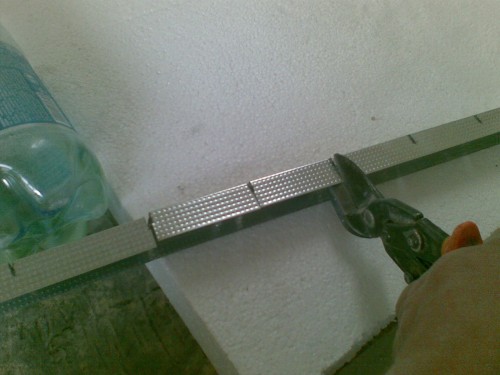
 After the draw circles cut guides segments and beaten them to the ceiling on radiuses, please note that we nailed the guides are not in all circles, but only on those that are on the first level from scratch.

понедельник, 24 сентября 2012 г.

Ceiling-suspended

Suspended ceiling represents a system consisting of a metal frame, to which are attached or ready-made elements (panels, boards, laths, the honeycomb modules, tapes), or plasterboard sheets, creating the plane of the ceiling. Use of a false ceiling leads to the formation of the space between the ceiling and the floors, which can be installed engineering communications and installation of fixtures.
The advantages of suspended ceiling

 Suspended ceiling allows you to easily hide the defects in the surface of the ceiling, as well as all equipment, which is above the ceiling. In addition, the design of the suspended ceiling to provide easy access to the equipment or in the specific desired location, or on the entire surface of the ceiling.

 If one of the modular elements was defaced or destroyed, it can be easy to replace, not wasting a lot of time.

 Acoustic suspended ceilings contribute to reducing the level of noise in the apartment, and does away with the annoying sounds. And their reflective properties allow to make the room is well lit with minimum power consumption.

Stretching ceiling

The suspended ceiling is a product, made from certain bands of the film PVC fabrics, which выкроено solely on the dimensions of the room taking into account all its characteristics. The density of paintings, as a rule, is 0.18 cm. Drawing for cutting must be performed by a professional engineer, as in this sphere, as in all other aspects, connected with the stretch ceiling, the mass of details, which should be taken into account. Apertures for the anchorages of the chandelier, the pipeline, in the area of the ventilation grate and fire engines, sensors are cut in the film and amplified склеенным the fixing element. The canvas is fixed to the hard plastic profile, attached to the walls of the room.

The warranty period on the ceiling, on the canvas to 15 years, the installation of 3 years.
The story of a stretch ceiling


As evidenced by the history, plus the history of origination of a stretch ceiling, driven by force of progress are human values, practical and aesthetic. Designer fantasy and construction experience more ancient Rome, stimulated by aggressively minded patricians, gave rise to the thought drape ceiling cloth. Fabric of matter tried to choose the color of the walls of the premises, and when in the course of time the cloth was covered with dust, bleached, SAG or simply bored, it replaced, and the ceiling again looked new.